
Corrupting Gaze - Gallery Weekend, Berlin, Germany, 2026 | Installation view

The Dissolution of Cain and Abel (I), 2026 | oil on jute | 190 x 130 cm
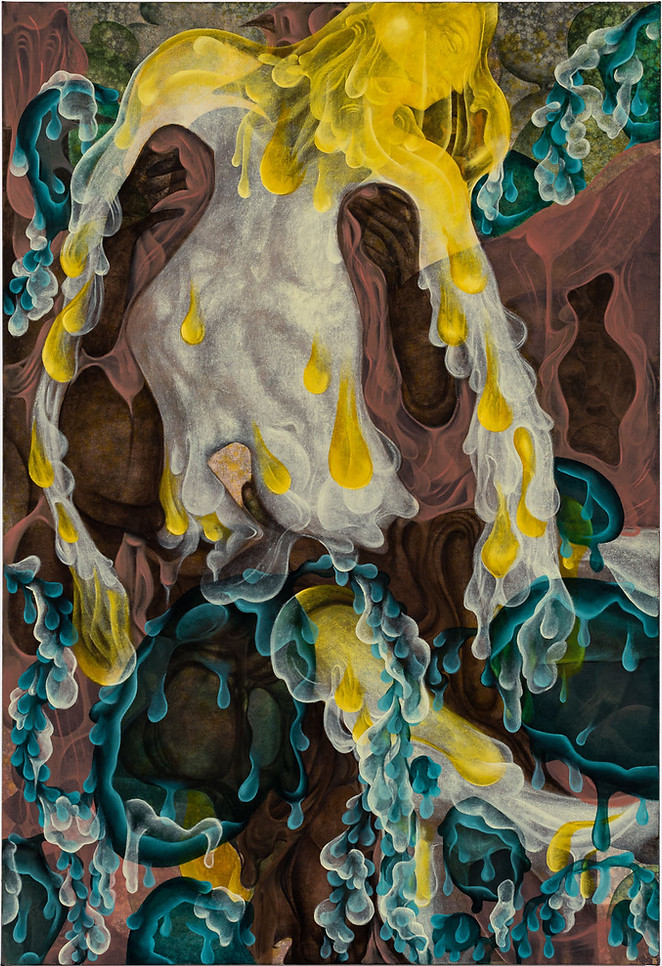
The Dissolution of Cain and Abel (II), 2026 | oil on jute | 190 x 130 cm
The Dissolution of Cain and Abel (I-II)
The Dissolution of Cain and Abel (2026), a pair of paintings, further explores my interest in hostile environments as spaces of disruption, change, and habitation. Rather than depicting a fixed landscape, the works unfold as unstable fields in which bodies, plant like forms, and shadowy presences continuously shift into one another. The ivory figures appear suspended in a state of becoming, shaped by the conditions that surround and hold them.
These ghostlike melting forms emerge as vulnerable bodies caught in a process of material change. The fluidity of their surfaces suggests shifts in state, where form alters while the fundamental substance remains unchanged. The shadow figures that support or contain these melting bodies imply an ambiguous force at once protective and oppressive, structural and spectral.
This logic becomes a metaphor for beings adapting to environments marked by pressure, instability, and threat.
Quasi botanical elements infiltrate the compositions, growing across and through the figures like organisms responding to altered ecological conditions. Rather than functioning as background ornamentation, these forms interfere with the bodies, merging with them and destabilizing clear boundaries between human, vegetal, and atmospheric matter. The work proposes an ecosystem in which all entities are mutually affected by the hostile conditions they inhabit.
The paintings are built through many layers, each one developing from the one below. Earlier gestures, forms, and atmospheres remain visible, quietly shaping the final image. This process mirrors the conceptual framework of the work itself that change is never an erasure but an accumulation. What appears on the surface carries the memory and pressure of what lies underneath, much like environments themselves are shaped by successive histories of disruption.

Corrupting Gaze, 2026 | performance still

Corrupting Gaze, 2026 | performance still
Corrupting Gaze
Living Sculpture
This work situates itself within and against the long, highly coded history of the reclining nude. From Grande Odalisque by Jean-Auguste-Dominique Ingres to Titian’s Venus of Urbino and Manet’s Olympia, the horizontal body has historically been staged for prolonged viewing: oriented toward the gaze, composed, and offered as a site of controlled eroticism. Ingres, in particular, stretches the body into impossibility, elongating spine and form to produce not a person, but a fantasy. His odalisque is already constructed: passive, othered, and rendered for consumption.
The sculpture echoes that lineage through the pose itself. Reclined on a chaise-like structure, one arm supporting the head, the figure presents itself frontally, unmistakably citing the odalisque tradition. Yet that familiarity quickly destabilizes. The surface, stretched and semi-translucent, reads as a second skin: artificial, prosthetic, almost clinical. Metallic forms interrupt the body, not as natural anatomy but as inserts, implants, foreign presences. The illusionistic softness of painting gives way here to a body that feels assembled rather than given.
The face, obscured or flattened, withholds psychological access. Where the historical nude invites the gaze, this figure resists it. It does not fully yield itself as an image.
In doing so, the work opens a queer reading of the reclining nude. This tradition has never been neutral; it structures who looks and who is made visible. Here, the body refuses stable categorization. It moves between genders, its forms ambiguous, its surfaces suggestive of fabrication rather than biology. The pose still carries the language of sensuality, but the material introduces distance. Desire becomes unsettled by estrangement.
This tension shifts the viewer’s position. Rather than passively consuming the image, one becomes aware of the act of looking itself, its assumptions, its habits, its power. If Ingres transforms the body into an object of fantasy, the sculpture pushes objecthood to its limit, turning the figure into something closer to artifact, construction, or residue. Yet in doing so, the work exposes the very mechanisms that produce such objectification.
The sculpture also departs from the Orientalist framework of the odalisque. Otherness is no longer projected onto a distant geography or culture, but onto the body itself, rendered synthetic, modified, and post-human. The figure becomes a site of intervention: a surface for projection, a container for alien elements, a body shaped through processes of control and transformation. In this sense, the work resonates with contemporary discourses on queer embodiment, cyborg theory, and the aesthetics of fetish and medicalization.
The chaise longue, historically tied to leisure and display, remains as a stage. Once associated with intimacy and bourgeois interiors, it now holds a body that appears constrained rather than relaxed, estranged rather than inviting. Comfort becomes tension; display becomes exposure.
If the odalisque once declared, “Here is a body for your gaze,”
this work responds differently:
“Here is a body that reveals how that gaze is constructed.”

Snowmen, 2026 | oil on jute | 150 x 150 cm

Vanitas, 2026 | oil on jute | 60 x 60 cm

Untitled (Reclining Nude), 2026 | oil on jute | 80 x 80 cm